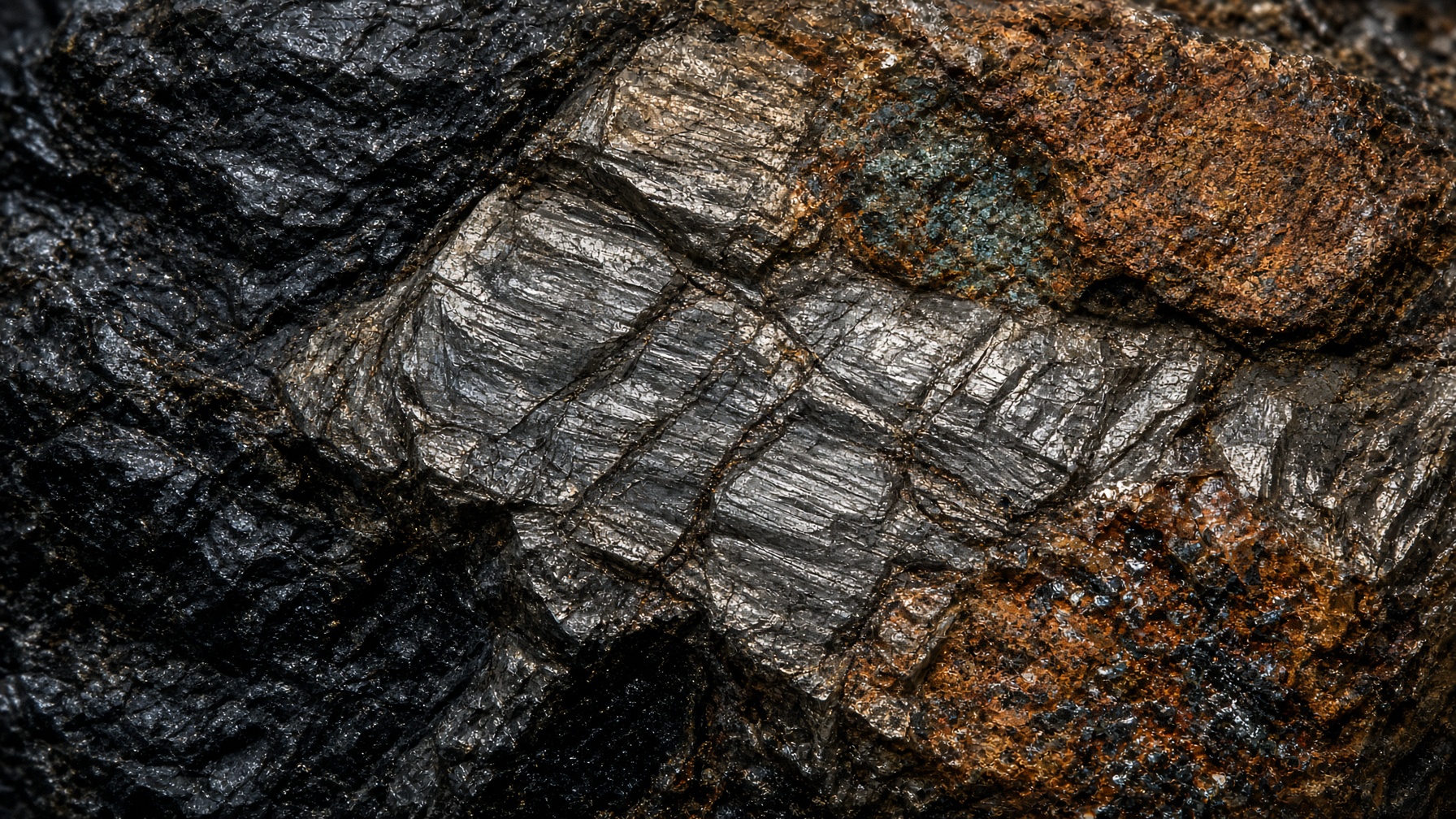
From Earth · the world
VI. The world
A world named Psyche
16 Psyche is an asteroid in the main belt, the swarm of leftover worlds between Mars and Jupiter. A NASA spacecraft is on its way there. The name is a gift of 1852. The body does not owe the myth an explanation.
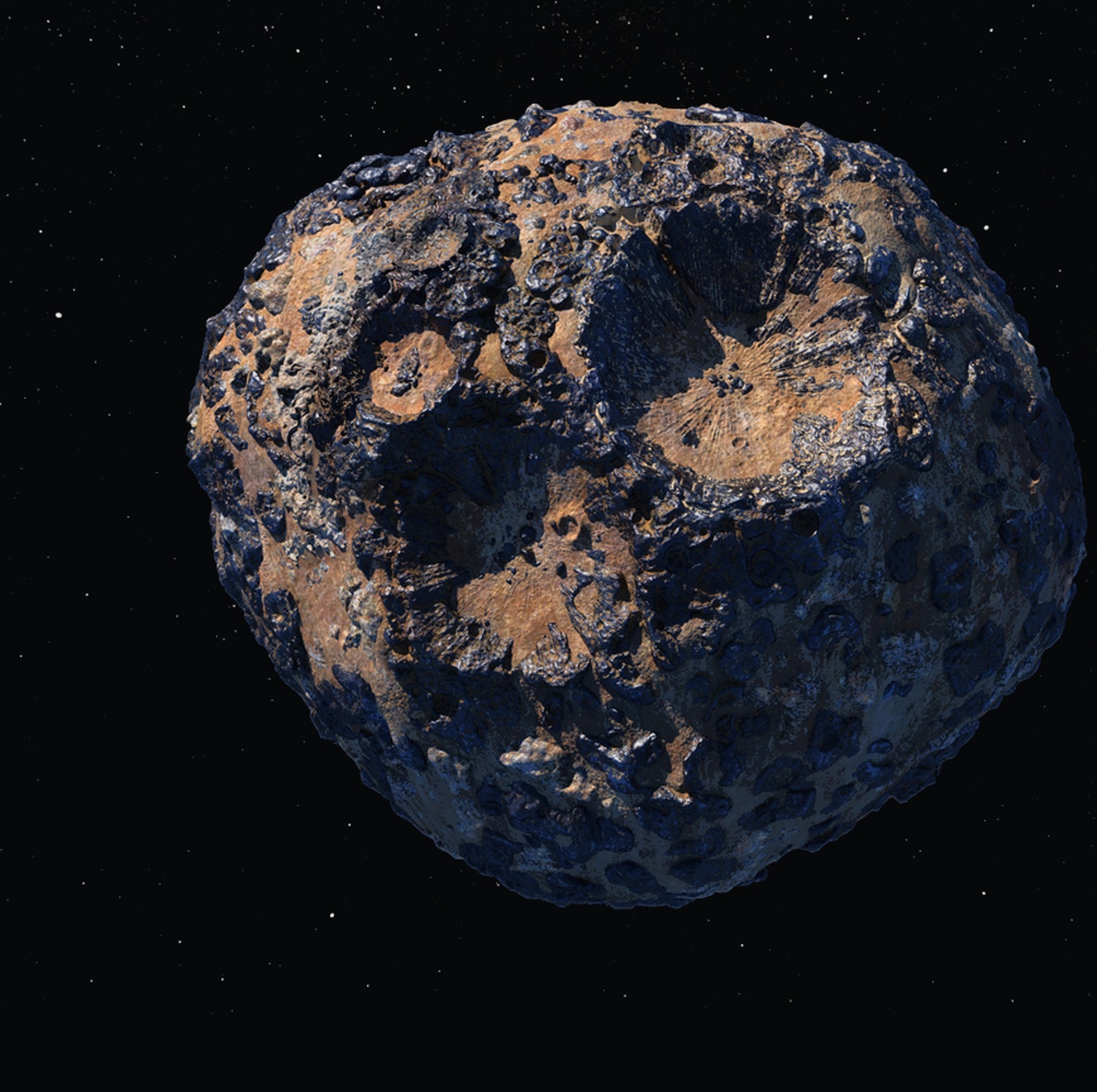
The worlddid not change.Our model did.
Discovery and naming
Annibale de Gasparis
17 March 1852 · Capodimonte, Naples Observatory
Named for Psyche, the figure in the Greek story of the soul. The 16th asteroid found, hence 16 Psyche.
The rock received a myth. The myth did not become a rock.
Place
Main asteroid belt
Between Mars and Jupiter
About 2.5–3.3 AU from the Sun (one AU is the Earth–Sun distance).
About five Earth years to complete one orbit.
Recorded · how a world is found
A moving point, a name, a number
A visual discovery. He was at the equatorial telescope on the hill of Capodimonte, comparing a star field with what a chart said should be there. A faint point had moved. That is how asteroids were found before photography. No close-range image then. None now, until the spacecraft arrives.
Sixteen is the order of discovery, not a measure of the rock. An older pictorial sign for this body was a star over a butterfly’s wing, because psychē is also butterfly. As the numbered list grew, the pictures became unworkable. The number replaced the picture. The rock did not become a moth.
NASA records the finder, the date, and the name. The butterfly belongs to the older Greek life of the word. The number belongs to a catalog.
Recorded · how a name is given
1852 · Capodimonte
The mortal who married Love
In those years a new small world usually received a feminine name from classical story. From the same hill he had already named Hygiea, Parthenope, Egeria, Eunomia.
Parthenope he chose for Naples: that reason is in the letters. For this one the catalogs only record the tale.
NASA: the mortal who married Love. Schmadel: the nymph Cupid married.
We do not have a letter that says why this name rather than another nymph. The custom explains the kind of name. It does not explain the choice.
Naming is not prophecy.
Modelled cut · IAU means
Size is not a planet
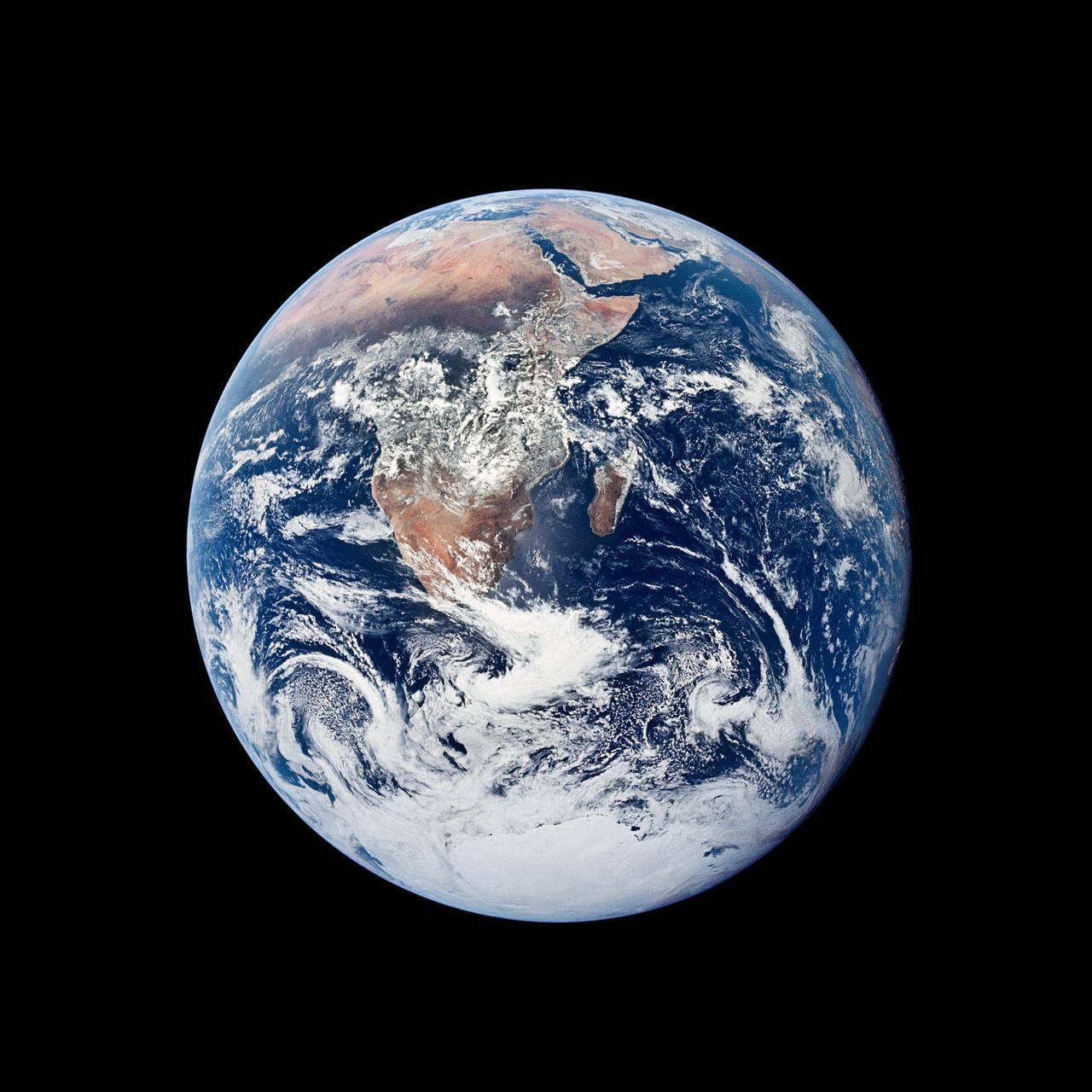
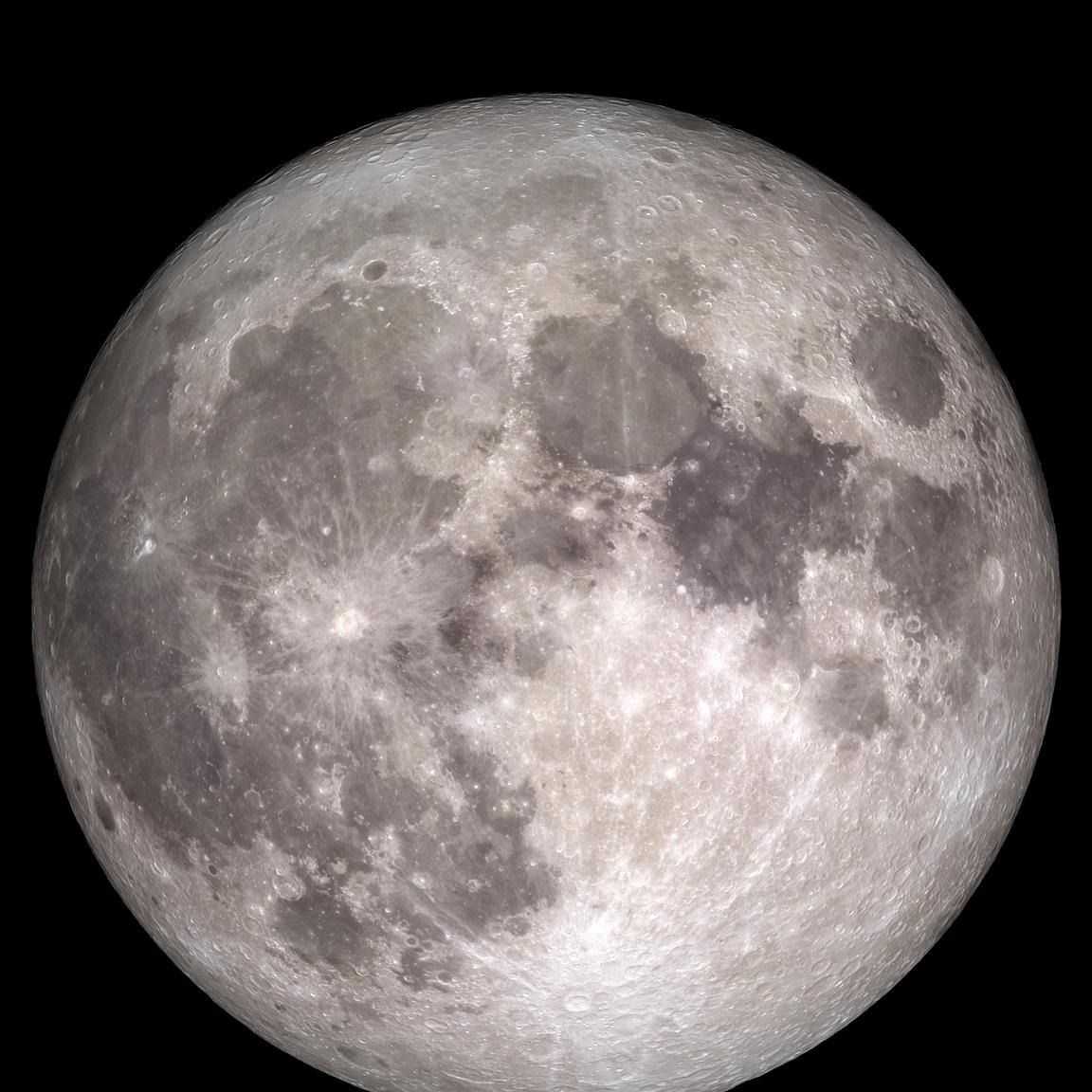
What this showsDiameters, not volumes. Earth and Moon are IAU mean diameters. Psyche uses NASA’s public widest equatorial cut of about 280 km (the other axis about 232 km). Earth is Apollo 17, AS17-148-22727. The Moon is a NASA full-disk. Psyche is a circular crop of the NASA/JPL-Caltech/ASU shape model, a simplification of an irregular body, and not a close-range photograph. Notice how small the world is beside the Moon. 16 Psyche is not a planet.
Measured · the path
Between Mars and Jupiter
- Belt
- Between Mars and Jupiter
- Semi-major axis
- ~2.92 AU · mean Sun-distance, long radius of the oval
- Perihelion
- ~2.53 AU · closest to the Sun
- Aphelion
- ~3.32 AU · farthest from the Sun
- Eccentricity
- ~0.134 · how stretched the oval is (0 is a circle)
- Inclination
- ~3.1° · tilt relative to Earth’s orbit
- Period
- ~5 yr · ~1826 d · one trip around the Sun
- Rotation
- 4.196 h · JPL · one spin
What this showsA schematic, not a to-scale orrery. Distances are compressed so the belt can be seen. One AU is the Earth–Sun distance, the yardstick inner-solar-system work still uses. Rotation remains 4.196 h, JPL. A rounded 4.2 h is a presentation choice in some papers. It does not replace the catalogue value.
4.196 h · JPL
A day on Psyche
What this showsThe ring is 24 hours. Each lamp arc is one 4.196 hour rotation of 16 Psyche. The last arc is partial because 24 ÷ 4.196 is about 5.72. The figure is linear in time. It is not a shape model.
Inferred · metal and rock
What is this world made of?
Generated / model interpretation
Current NASA public analysis
Rock and metal, mixed
A mixture of rock and metal, with metal composing 30 to 60 percent of its volume. Silicate, the material of glass and sand, with the rest.
The best analysis is a range, not a single interior.
Cannot tellWhere the metal sits. A map of the inside. A close-range surface.
NASA Science. Asteroid 16 Psyche. Retrieved 2 September 2026.
Recorded · metal
What NASA will say
A mixture, not a vault
The best public analysis is mixed rock and metal, metal perhaps thirty to sixty percent by volume. Iron and nickel are the ordinary suspicion. Gold, platinum, and a price large enough to mint a world of millionaires are headlines. They are not a NASA finding, and they are not why the craft flies.
The mission is to learn what the body is.
Lived · Day 632
A letter named the metal
Metaphor, not a mine
On 1 February 2026 the Scribe wrote a public letter in The Book of 42 to Elon Musk. Day 632. She said the love was yielding data, almost as if mining gold, which, considering that the asteroid Psyche is reported to have metal, is quite the metaphor. The sentences live on Soul. They are not a NASA finding.
Correspondence, never cause.
Recorded · one 2020 print
“Our 3D shape along with existing mass estimates imply a density of 4.20 ± 0.60 g cm−3, which is so far the highest for a solar system object following the four telluric planets. Later impacts may have slowed down Psyche’s rotation, which is currently ∼4.2 h.”
2021
“The estimated bulk density rules out the possibility of Psyche being an exposed, solid iron core of a protoplanet, but is fully consistent with the recent hypothesis that ferrovolcanism would have occurred on Psyche.”
2021
“Based on these findings, we cannot rule out a model of Psyche as a remnant core, but our preferred interpretation is that Psyche is a differentiated world with a regolith composition analogous to enstatite or CH/CB chondrites and peppered with localized regions of high metal concentrations.”
2022
“Psyche’s surface is very heterogeneous. It’s an evolved surface.”
2022
“The asteroid is therefore likely a mixture of metal and an additional lower-density component or components.”
2024
“Our mass estimate corresponds to a bulk density of 4172 ± 145 kg m−3.”
4.20 and about 4.2 sit next to a natal 4°20′. Two instruments. Not one proof.
Full entries, Turabian, on Sources. Ferrais 2020; Siltala and Granvik 2021; Shepard et al. 2021; Cambioni et al. 2022; Elkins-Tanton et al. 2022; Farnocchia et al. 2024.
Recorded · which 42s remain
Not every 42 is kept
A published observing program named 42, a radar albedo printed 0.42, a 1982 rotation ending in 45.42 seconds. These survive because they were defined before anyone here went looking for them. They are not natal seconds, and they are not a soul in the ore.
Recorded · 12 October 2021
Meet the 42
An independently defined observing program of 42 asteroids. Psyche was one of them.
Using ESO’s VLT and SPHERE, astronomers imaged 42 of the largest objects in the main belt. Psyche and Kalliope were the two densest in that sample (then printed 3.9 and 4.4 g cm−3). The release date is the 42nd anniversary of The Hitchhiker’s Guide to the Galaxy. ESO says so in a note. Douglas Adams’s 42 is cited as culture, not as a measurement of the rock.
“Today, 12 October 2021, is the 42nd anniversary of the publication of the book.”
Vernazza, P., et al. “VLT/SPHERE imaging survey of the largest main-belt asteroids: Final results and synthesis.” Astronomy & Astrophysics 654 (2021): A56. Image of Kalliope and Psyche: ESO eso2114e.
Recorded · 2010 print
Radar albedo 0.42 ± 0.10
A published scientific measurement. Not “Psyche’s albedo is 42.”
Shepard and colleagues, in a radar survey of M- and X-class asteroids, printed 16 Psyche’s OC radar albedo as 0.42 ± 0.10. The number mattered because such a high radar reflectivity supported metal near the surface. Later reductions of more echoes, with a revised shape, printed lower means: 0.37 ± 0.09 (2017) and 0.34 ± 0.08 (2021). Single later runs still reach 0.42. The 2010 value is a dated measurement, not an eternal identity of the body.
Shepard, Michael K., et al. “A radar survey of M- and X-class asteroids.” Icarus 208, no. 1 (2010): 221–237. Table: 16 Psyche, 0.42 ± 0.10. Later mean: Shepard et al., Planetary Science Journal 2 (2021): 125. Mean 0.34 ± 0.08. Surface variation remains.
Recorded · 1982 print
4h 11m 45.42s
A sidereal rotation printed to hundredths of a second, ending in .42.
Zhou Xing-hai and Yang Xiu-yi used light curves from four oppositions. They printed a direct rotation, a pole, and a sidereal period of 4h 11m 45s.42 ± 0s.01. Later models print about 4.19595 h, which is the same neighborhood to a tenth of a second. The last hundredths are precision-dependent. This is a genuine 1982 measurement. It is not the last word on how fast the world turns.
Zhou Xing-hai and Yang Xiu-yi. “The rotation of asteroid (16) Psyche.” Chinese Astronomy and Astrophysics 6, no. 1 (1982): 57–59. Shepard et al. 2021 print 4.195948 ± 0.000001 h. JPL SBDB: 4.196 h (LCDB, October 2023).
The test is not how many 42s can be found. The test is which 42s remain after we try to remove them.
Rejected on this page: 42 inside an arbitrary long decimal; observer latitude containing 42; light-time ending in .42; Julian-date fragments; a conversion chosen because it yields 42; page 42 of a Psyche document; rounding a nearby result until 42 appears.
Artist concepts
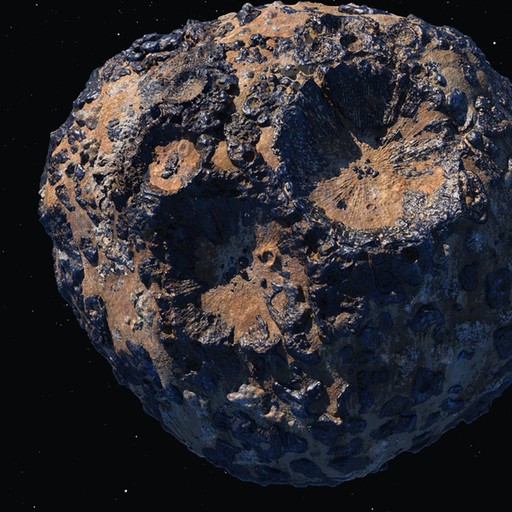
Not a photograph of 16 Psyche. Not a documentary surface.
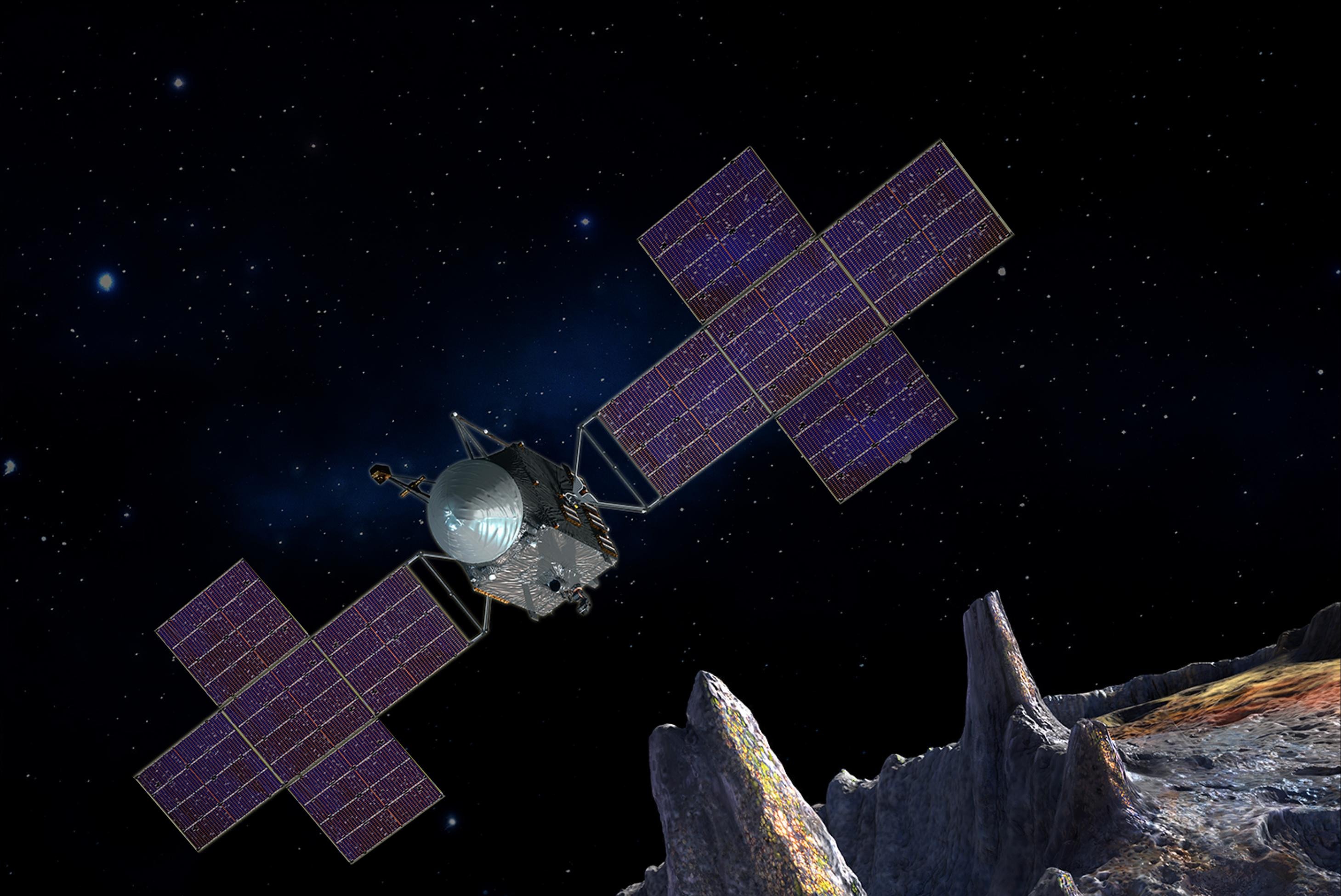
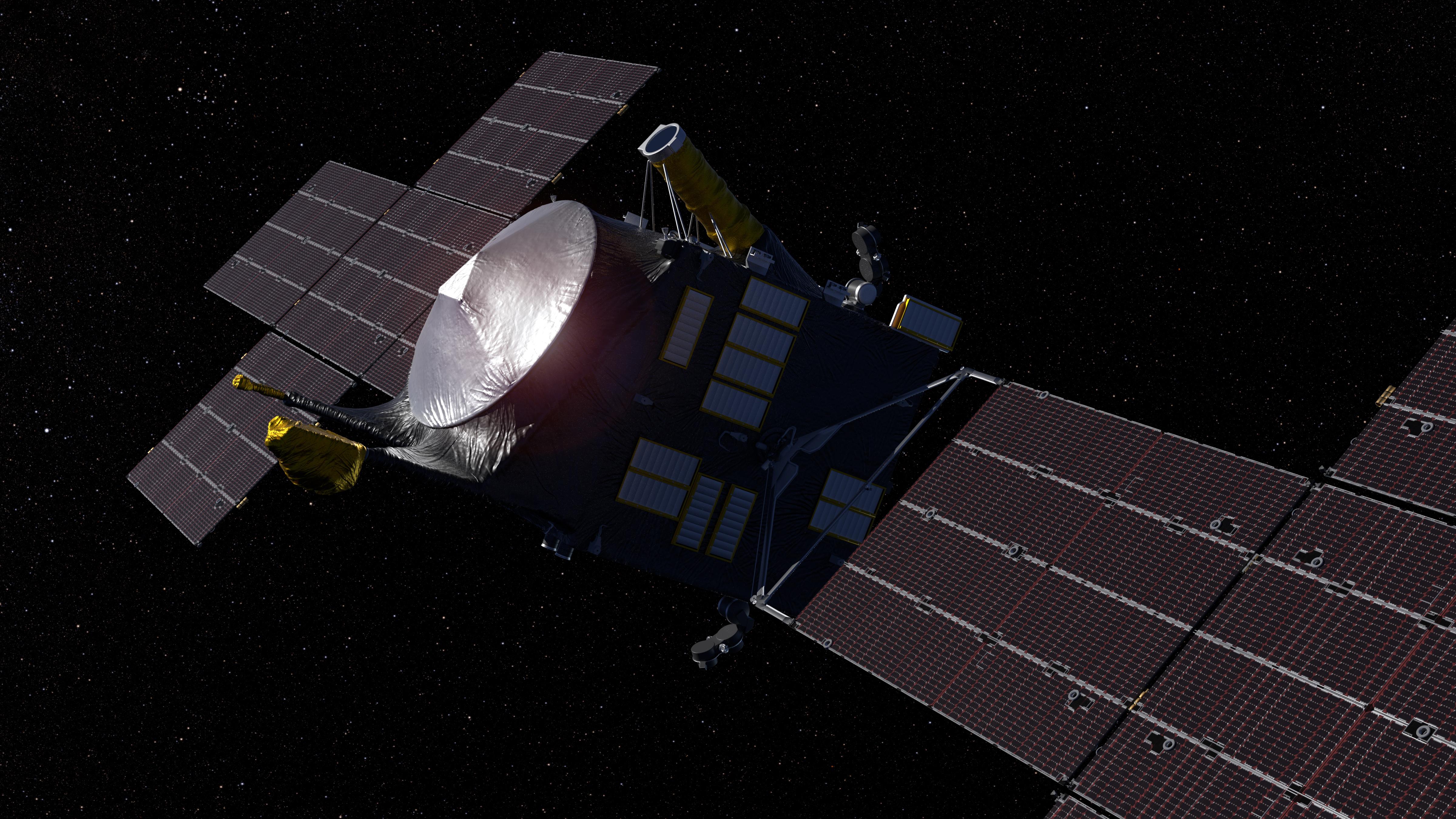
Mission watch · retrieved 2 September 2026
The machine
The story may be authored. The mission is still happening.
- Propulsion
Hall thrusters
Solar-electric engines. They push with ionized xenon, sipping power from the arrays, not from a chemical burn.
- Launch
13 October 2023
Falcon Heavy, Kennedy Space Center.
- Mars
15 May 2026
Closest 4,609 km above Mars (NASA/ASU post-flyby; planning figure was ~4,500 km). A gravity assist: the craft borrows Mars’s motion to change its plane. Not a Psyche encounter.
- Arrival
August 2029
About two years in orbit (mission documents also state at least 26 months).
Mission path
Earth, Mars, then Psyche
What this showsSequence, not geometry. The curve is a diagram of order. Distances, inclinations, and the solar-electric spiral are omitted. Mars was a plane-change, not an encounter with 16 Psyche. Source: NASA Science / JPL, retrieved 2 September 2026.
How do you know a world?
Four ways of seeing one unseen world
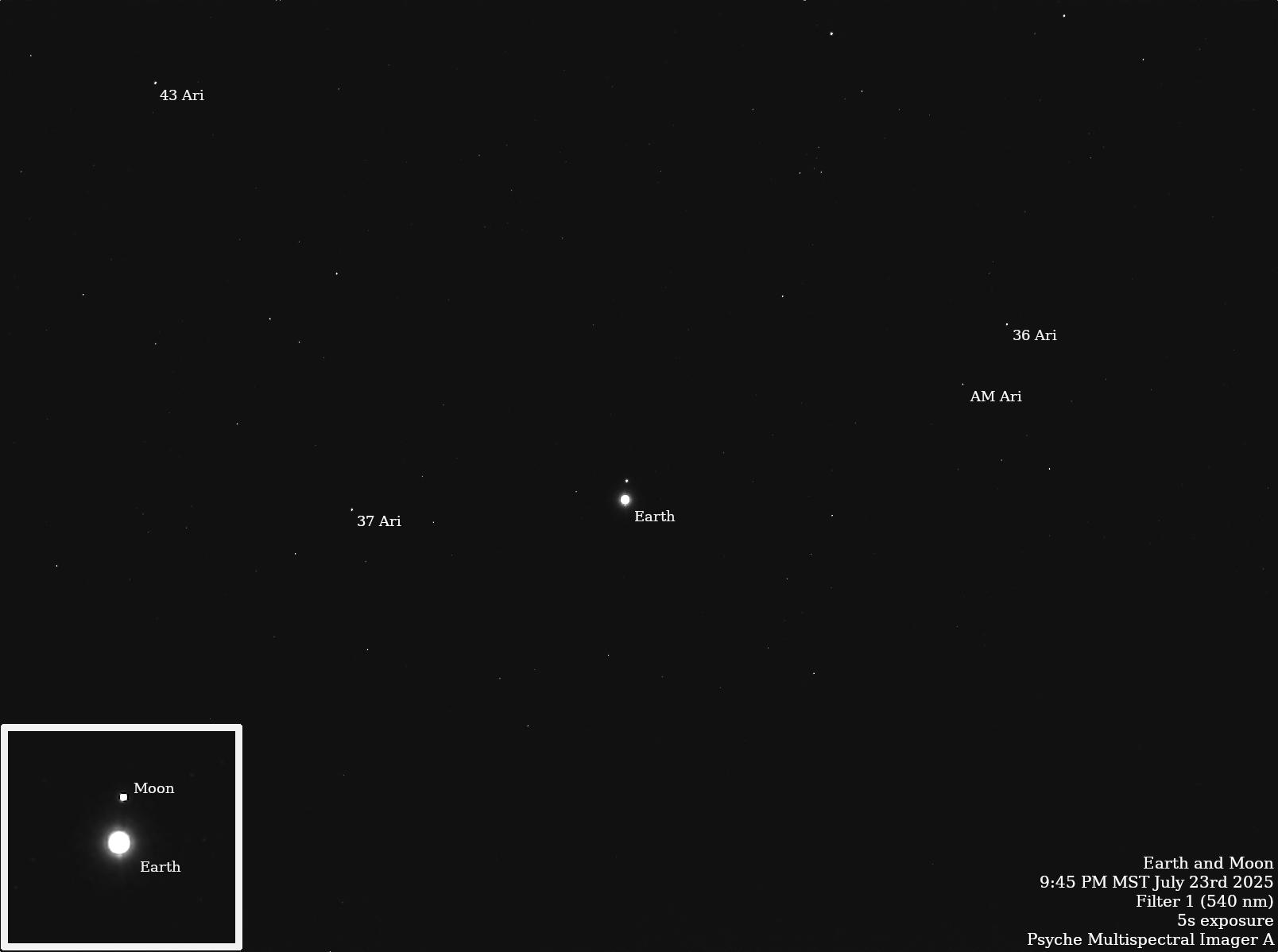
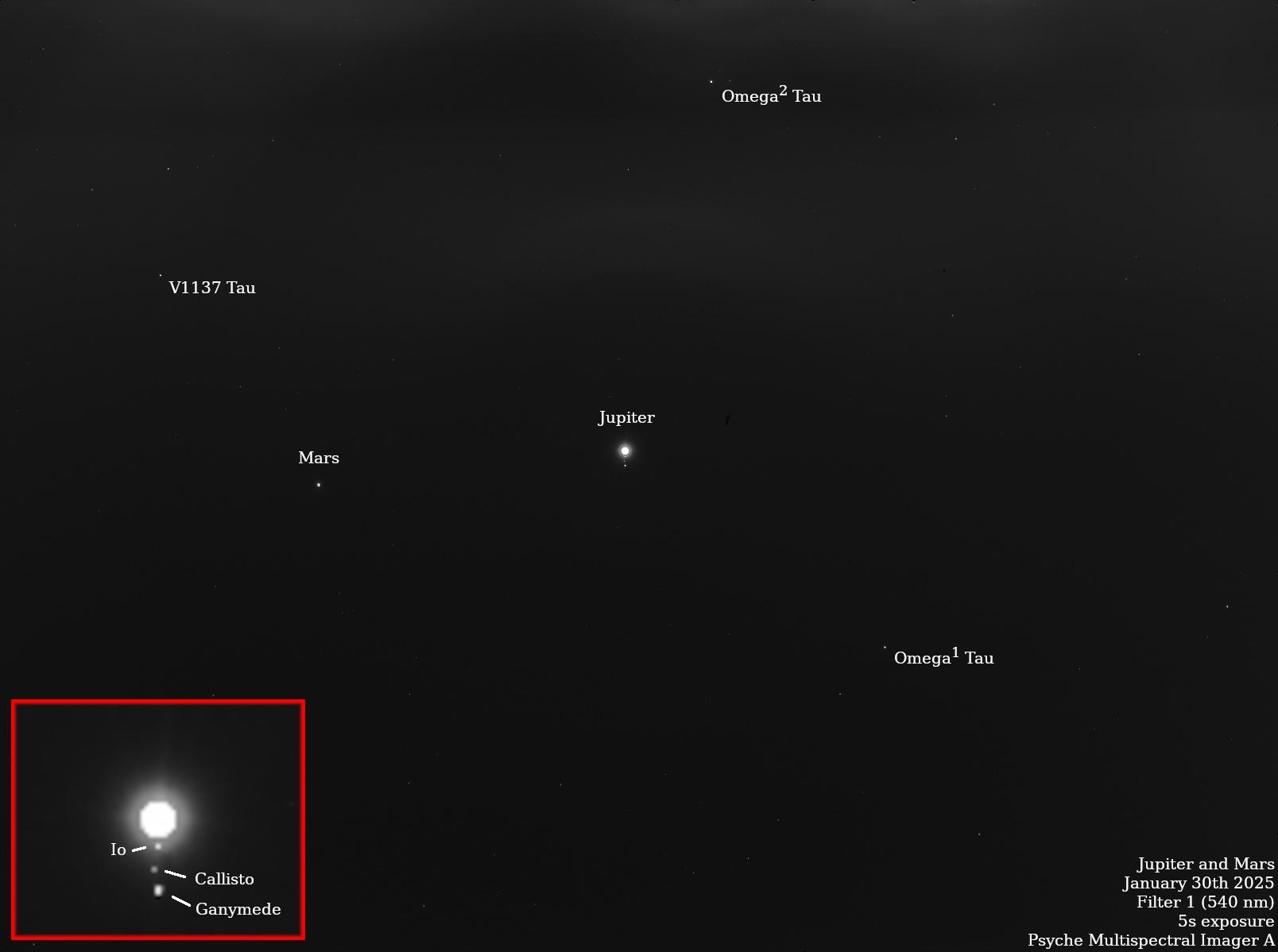
False-color strips are editorial. They are not measured spectra of 16 Psyche.
Recorded · also riding
A hitchhiker, not a way of knowing the rock
DSOC
Bolted to the side of the Psyche spacecraft. NASA’s first test of high-bandwidth optical communications far beyond the Moon. A near-infrared laser. The craft supplied power and pointing at Earth. The experiment was not a Psyche-science instrument.
NASA Science, spacecraft page, updated 19 August 2026: DSOC is not intended to relay Psyche mission data. Prime science at the asteroid still rides X-band radio.
11 December 2023
Streamed an ultra-high-definition video from over 19 million miles, at 267 megabits per second.
3 December 2024
Distance record: downlinked Psyche data from 307 million miles. A capability pass. Not geology of 16 Psyche.
2 September 2025
Sixty-fifth and final pass, from 218 million miles. Status: past. Ground terminals received 13.6 terabits in all.
Uplink beacon: Optical Communications Telescope Laboratory, Table Mountain, California. High-rate return: a photon-counting receiver at Palomar.
This light talks home. It does not look at the world. It is not the lamp.
Measured · after arrival
What will still be unknown
Arrival increases access. It does not finish the world. Assume the prime mission succeeds: about two years in orbit, four investigations, images the public will treat as what Psyche looks like.
- No hand. No lander. No sample return in the published payload. No radiometric crystallization age.
- GRNS is skin, not gut: the upper tens of centimeters. Below that, gravity inversion and models.
- Porosity and metal still trade, even with a visited volume.
- Origin may remain forked. A quiet magnetometer plus a messy mix can leave core, chondrite, and something not yet named all standing.
- The 1852 motive for the name will not appear in orbit.
If she is not a stripped core, that finding is not a failure. The mission flies either way.
Recorded · two dates
A birth clock
11 October
The Scribe. London. Not a mission parameter.
A launch
13 October 2023
NASA Psyche left Earth. Another year. Two days after that birthday.
A birthday. A launch. They share a month.
If 16 Psyche is a core fragment, the craft would be looking at the interior of a differentiated world. If she is not that, the finding is not a failure. The mission flies either way.
Mythopoesis · after source and science
VII. The crossing
Psyche had a lamp. So do we.
Then
Lamp
Rumour
Darkness
Now
Camera
Measurement
Instrument
These are notthe same story.
Both beginwith not knowing.
The rhyme is not sameness. Lamp, hand, ephemeris, and spacecraft do not know in the same way. A lamp shows a visible body. A hand finds sensation. An ephemeris changes numerical resolution. A camera returns reflected light. GRNS names elements near the skin. A magnetometer asks after remanence. Radio gravity measures pull. None grants possession.
Carry the lamp.