What doesit meanto see?
Interpreted · the eye
The eye
To look is to infer: light, angle, memory, wish. A looker completes what is partial and calls the completion knowledge. Psyche’s lamp is a scene of this. Seeing costs. Knowledge can be a wound.
Interpreted: seeing changes the conditions of the relationship. The Latin does not say that darkness was the condition of love.
Lived · the gaze
The gaze
There are eyes that hold a room without offering their owner. A public face is not a private weather report. What looking awakened in a watcher belongs to the watcher. It is lived. It is archive. It is not a decoding of the person looked at.
The eyes may invite attention. They do not grant access to another person’s interior life.
Interpreted · a literary rhyme only
She had to look
Apuleius does not sanitize the lamp. She takes it up against a command. Seeing costs. A woman learned to look more closely. No historical chain joins a Latin novel to a London morning in 1978.
The novel and the morning do not have to be kin.
Lived · who walks
The Scribe
A living person, not a character in Apuleius
These rooms are walked by a woman the pages call the Scribe. The Book of 42 is her chronicle of noticing. PSYCHE is not her life put into costume. It is the place where a Greek word, a Latin tale, a natal coordinate, and a NASA target are kept distinct, because they share a name.
She is not Psyche. She looked. That is the only claim this page needs before the body.
Lived · the body first
The knot she didn’t know was there
Pressure found the place. A knot, a trigger point, became perceptible under a hand, and tenderness made it legible. Surprise came before explanation: she had not known it was there.
This is ordinary repeated lived experience for the Scribe, across massages, not a single literary device. The therapist did not put the knot there. Pressure changed access to something she had not consciously noticed. Day 632, 1 February 2026, is one such sitting, named in a public letter. The phenomenon is older than that letter.

Sensation
Pressure. Heat. A holding that does not yet have a story.
Lived · an earlier sentence
He restores my soul
Long after a familiar sentence, “He restores my soul,” had unexpectedly exposed a need she could not yet name, another unnoticed thing became perceptible under a hand. She was teaching her children the twenty-third psalm when words she had said before would not stay ordinary. She burst into tears. She did not fully understand why. The Book later writes: she had been cracked open by a sentence about being put back together.
The tears are not a diagnosis. They are not proof that a soul is a measurable entity. They are earlier evidence of the same question: something can become perceptible before the person has language for what has become perceptible.
How much of a life might already be shaping a person before she has the language, safety, or attention required to perceive it?
Psyche’s lamp did not create what waited in the dark; it changed what she could see. The hand on the knot did not manufacture the tenderness; it brought the tenderness into attention. Later, when the Scribe’s natal sky was calculated closely enough to refuse the round, asteroid 16 Psyche did not sit at a clean 0°00′ of Sagittarius. It had already crossed the gate by forty-two arcseconds. Nothing happened to the asteroid when the resolution increased. What changed was access to information that had been there all along. The coordinate lives on Soul.
The parallels are literary. A muscle knot is not a soul wound, and an ephemeris is not a nervous system; looking more closely does not guarantee an explanation. Scripture, somatics, and astronomy are not one mechanism. The rhyme is not sameness. What the three scenes share is smaller: the sentence, the hand, and the instrument each change the conditions of looking.
Interpreted · later research
The books came after the question
Bessel van der Kolk’s The Body Keeps the Score and Mark Wolynn’s It Didn’t Start With You did not enter because of that one massage. They entered through later research into psychosomatic pain and the relationship between experience, body, memory, inheritance, protection, and symptom. They are doors in a subsequent inquiry. They do not certify the knot.
A knot does not authenticate a memory. Tenderness does not prove a hidden event. Sensation may open a question. It does not supply the story. A sensation cannot authenticate a forgotten event, and one generation does not survive inside another as intact autobiography. Experience can nevertheless persist through nervous-system responses, attachment, learned behavior, family relationships, stories, silences, and patterns of protection that may begin before a person understands where they came from.
The instrument preserves that uncertainty. As pressure changes the field slowly, the reader is invited to remain with whatever becomes perceptible.
warmthresistancetendernessan associationa memoryor nothing that asks to become a story
Nothing is assigned a meaning, and nothing is certified as hidden trauma or inherited history.
Recorded · Plotinus
A theory of looking as likeness
He is not the lamp, and he is not the rock
Three: the One, Intellect, Soul. Soul is the third, not a stone in a pocket. The body is in soul more than soul is packed in the body as in a container. World-soul and particular souls are kindred. A higher part, he held, does not fully descend (Enneads IV.8).
Never did eye see the sun unless it had first become sunlike, and never can the soul have vision of the First Beauty unless itself be beautiful.
Not Apuleius. The Latin novel does not require the looker to have become beautiful. Psyche looks, and the looking costs. Not Hillman’s “perspective rather than a substance,” though both refuse a gland in the ore. Not a finding about asteroid 16. Not possession of another person’s interior.
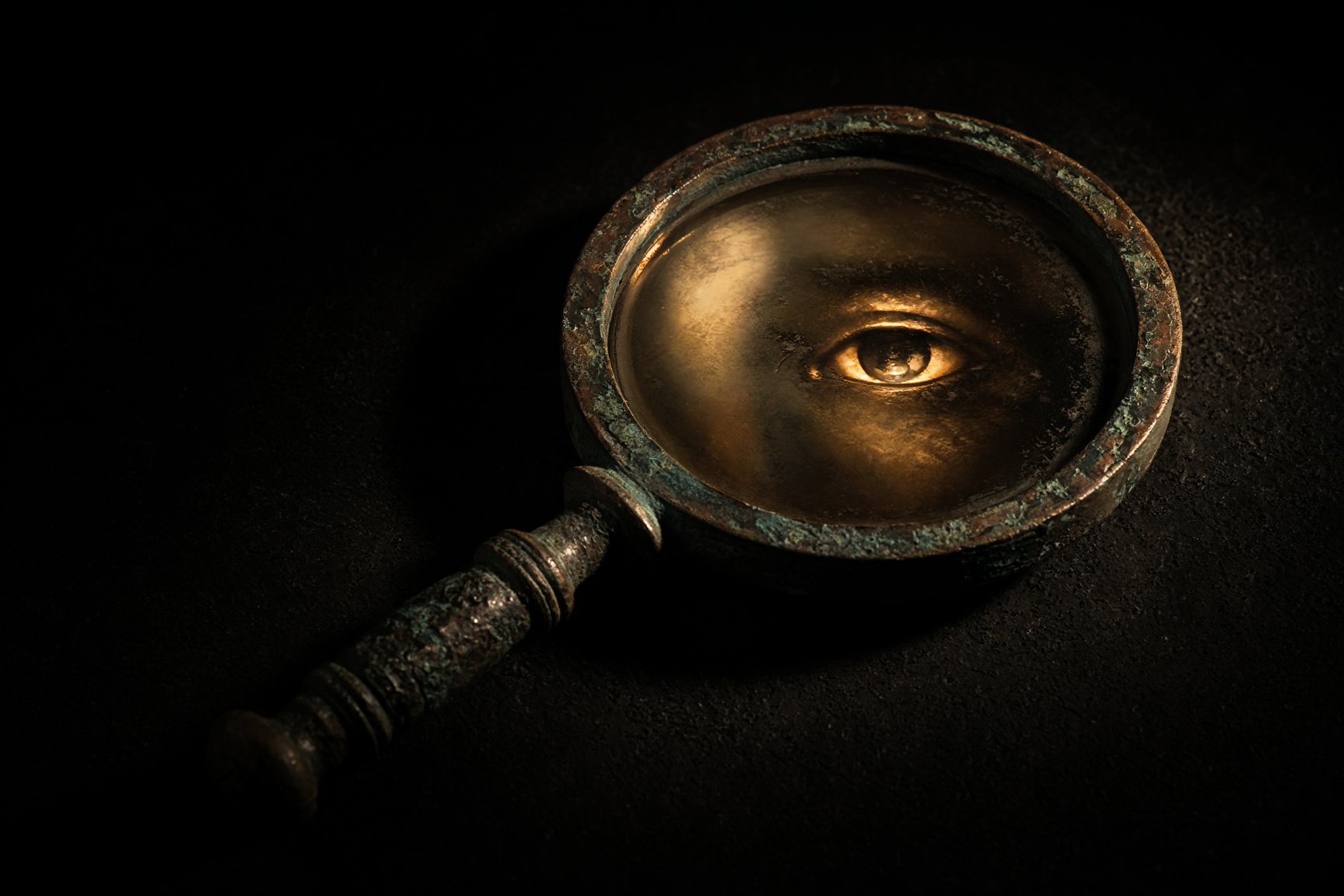
Eyes arethe windowto the soul.
Interpretive object. Looking returns a fragment, not a soul. Not a portrait of a living person.
Look up.She did.